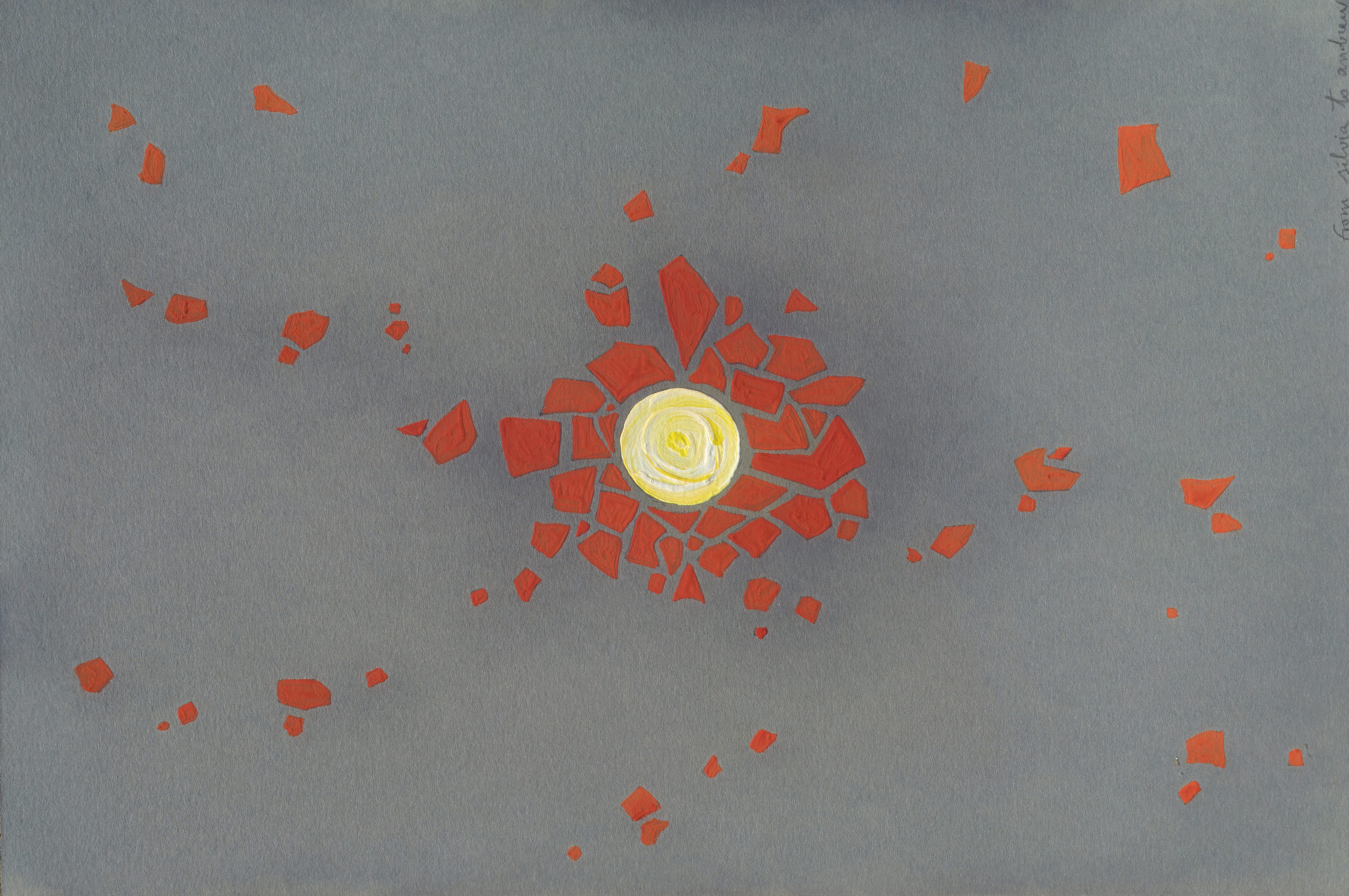
Strong Centers

If you haven’t had the chance, I’d love for you to meet Richard Bartlett someday. Along with his wife, he runs Casa Tilo, a home outside of Barcelona where people come to explore themselves, work, and relate to each other. He has this warm presence that isn’t quite charismatic, at least not directly.
I’ve known charismatic people, the kind that light up rooms and have a magnetism about them. Many, not all, of these people also have this feeling of sucking energy out of a room. It’s as if the attentional energy flows to them, and then out.
Rich isn’t like that. Instead, he has this attunement towards creating space where none existed. Many things can emerge from this. Sometimes he’s obviously leading, and sometimes not. Yet, things happen around him. To be clear, he’s not doing anything you nor I couldn’t do. He picks guests up at the train station and makes the beds himself. He borrowed money to cover the first year’s rent. He’s described his desire as creating scene-building infrastructure for other people’s relationships.
There’s been several people I’ve found this quality in. I’m drawn to them, as I’m sure you are too. One thing they have in common is that they notice things. Once someone was asking Rich how to get into birdwatching, and he casually told them to just spend time in places that have birds. That over time, you can build this attunement: he knows when the cat is coming because the local swallows make a special call.
I hope you can feel the depth he has. Sometimes things don’t have to be complex.
What is this quality? When we revisit “charisma”, it still doesn’t fit. There’s no performance, and if I tried to locate the quality in him, it slips. Rich alone in an empty house isn’t it. Casa Tilo without Rich is a nice property in a forest. This thing is somehow in the relationship between him, his wife, the place, the events, the people who come, and all the wildlife near the home. Whatever this strength is, it doesn’t seem to be his, exactly.
Christopher Alexander noticed this pattern in architecture and place. He called these gatherings “centers”. They’re not necessarily, directly, in the center of anything. I like to think of them as clusters of saliency, or of meaning. But never removed from everything they relate to: what’s around them, what they’re made of, what they contribute towards. So they’re not “things”, in a direct sense. They feel more like a presence known entirely by its effect on the field around it.
If a center is not a thing, we can’t directly isolate and touch it. He describes it as a gathering together of the structure of space, which forms a pocket or field effect. Strength comes in degrees—we may find more or less of it—and it’s enacted.
Wherever he noticed them, he tuned in to how their significance came entirely from their relationship with everything around. A birthday candle means something different in a box with 19 others, versus on a cupcake. And it gains new significance if we see it next to a one-year-old on their birthday, surrounded by their loving parents, eyes opened wide, about to experience their first sugar rush.
Alexander noticed this in color. He was trying to make a red radiate and glow. He adds more red, and it seems just as static. More red, and it feels washed out and dead. More again, worse. How could he make the red sing? Almost against intuition, he starts to work in flecks of purple, orange, pink. He even adds small places where a tiny spot of blue shows through. All of a sudden, the red catches. It finds more redness as it stops being the only thing. And strangely, all the other colors are glowing too. He became convinced this wasn’t a quirk of paint. A color that shines is a color that brightens the colors around it, as if that’s what being strong is.
“Nothing can be a center by itself. It becomes a center and gets its life at the same time, and through the same process that brings all the other centers to life.” — Christopher Alexander
Or, consider one dot on a blank sheet of paper. Perceptually, the whole sheet reorganizes. An attentional halo appears around the dot, and with it regions, a near and a far. We can feel the same thing at the beach. If a person puts a first towel on empty sand at a beach, suddenly the beach has a geometry. The next group doesn’t set up just anywhere. They land near, but not too near. One little mark, and a field of meaning emerges where it hadn’t before.
The thing I’m drawn to, in Rich, is that he’s a strong center.
Alexander was focused on place, and so noticed that strong centers define our saliency field. Great places have strong centers that never stand alone. Each is made of smaller centers, and lends strength to the larger ones it sits inside. A fountain needs a courtyard, and once established, the courtyard comes to need the fountain. If we try to locate the strength in either one in isolation, it slips again. Significance seems to live in the coupling itself.
I love finding them outside of place, because the function is the same. I have this habit of naming group chats something silly. It started as a joke, but then I noticed that once a group chat is named, it becomes a thing (one of my longest running is Doggy Dating, because friends of ours had a dog that liked our dog). The legibility is like a marker, one that doesn’t really mean anything, but that encourages more interaction. It’s like it creates a landing pad that interaction can naturally gather around. Four people who text is just a thread that can get easily lost. Once it has a name, there’s a stronger center, like the towel on the beach.
I have a weekly breakfast with my friend Noah, called The Writing Workshop. It has a short theme song (the audio recording of this essay has a sample). We created it to write more, and quickly realized we didn’t love writing all that much. We didn’t even want to talk about writing. But talk, we have. Philosophy, experience, religions, patterns we’ve noticed, hardship, anything. Many hundreds of hours in and the writing pretext is long gone, yet strangely the name still feels important, like a center for the whole thing even happening. Neither of us owns the workshop. Both of us are organized by it.
Centers also don’t need to be legible. I love watching people at parties and how they gather. Somehow the party always ends up in the kitchen, by no one’s decision. Energetic clusters emerge, often by the food or the drinks, and when one grows too large, or its conversation crystallizes around something not everyone wants to be inside of, there’s this palpable diffusion energy that builds. People peel off and seed new centers, drifting between them by interest and feeling. The field reorganizes all night, made entirely of where everyone else is. It’s quite lovely to notice.
Earlier I mentioned how this sense isn’t directly charisma. But charisma can be a functional center. It can also be repulsive. I’ve found charisma-by-itself feeling off—perhaps, manipulative?—because it’s charisma at me. It feels like a performance, extracting attention rather than metabolizing it. Other forms of charisma really are centers, fully responsive to the room they’re in. If we removed the responsive attunement, leaving behind just charm, it’d feel waxy and off-putting.
I’ve been to tech networking events where you can feel this dynamic. Some people arrive needing to be seen, to be important. They work the room. I know this, because I’ve done it. It feels like a performance, like work. There’s something I need, and I’m trying to get it. Be impressed by me! Honestly, the strain is exhausting. I’ve been that way, working hard, believing all the strength must be self-generated.
In social contexts, being a strong center is much more about direction of flow, less about extroversion or introversion. Sometimes a room organizes around its loudest member, such as the exuberant host who makes everyone funnier. Sometimes around a quiet, wise personality. So it can’t be just loudness or visibility. Does their presence brighten what’s around? When it’s genuine, there’s no obligatory hook, nothing angling for a grip on you.
We keep seeing it: centers make other centers. Groups have this dynamic as well. A modern pathology is never having a group center. We’ve built a world that works well for individuals and for crowds, and it’s oddly thin everywhere in between, at the scale of a dinner table or scene. Healthy, alive groups have gravity. Perhaps around a topic, an activity, a space, a shared interest. Rich has spent twenty years on exactly this question, and his conclusion, reached from a completely different direction than Alexander, is that “no gravity” is not the problem. Groups fail through hidden centers, or coercive ones. A group with no obvious center usually has one it can’t see, or won’t admit to.
There’s also the space apart from centers. It’s not worse, directly. In fact, I’ve had lovely experiences in places that feel like they have basically no salient center, no gravity pulling in any direction. But this reminds me of friends whose relationship was ending. The center, made in the substrate of their relationship, had become weaker and weaker. No one’s to fault, but nothing really flowed towards it anymore. Both people are still intact and functioning. Each person started figuring out how life might be apart, with dreams and aspirations that increasingly included the other less and less. It seems the strongest centers in a life are ones no one person owns.
It’s also not just a lack of substance. I’ve had weeks like this, nominally full (in the busy sense), that didn’t feel like they built towards anything. No real commonality, no real cohesive energetic pull. Close friends who have had children describe the first few months as strange in a related way. It’s not that there’s no center. There’s one immense center, and it flattens all the others. Every other gravity in their life goes quiet, and the weeks still lose their shape.
People who know me well know that I have, at all times, many tabs open. Often hundreds. This patterning has encouraged incredible breadth in interests, but also a scatteredness that I feel. When I have 234 open tabs, none are important. Shall I read this new AI paper? Or make a Sichuan peppercorn tincture? Or read an essay a friend wrote? Oh I know, I could buy these linen curtains from Etsy. And finish my friend’s Alexander Technique course. So much happening, and no peak of saliency anywhere.
One fascinating pattern from seeing centers is how centers open up space around themselves. There’s weight and meaning, and also space and clarity. A courtyard, after all, is mostly emptiness. Or, might I interject: potentiality. Without a center, it turns out there’s no space either. My scattered weeks feel so full, and still hollow.
A non-attuned center (like the charismatic attention sink) and a scattered field look like opposites. One has too much gravity, the other none at all. But they seem to me like the same mistake: both have lost the mutuality that gives them strength. The grasped center pulls everything towards itself and somehow still starves. The scattered field never gathers at all. Neither one is in real relationship with its neighbors.
In the introduction, we talked about the deadness of model homes. They’re sort of like a fortress: staged, contextless, open for anything and thus nothing. They’re separated from everything that might give them meaning. No salient center. Yet the alleys near me are the polar opposite. They’re entirely honest, if that were possible. Their strength arrives from all the relationships that clearly and obviously lean into them: the gardens, the bark-y dogs, the half-finished projects, the private lives mixing with the public street.
We are centers. I mean this quite literally, without mumbo jumbo trappings. In the same way that my Writing Workshop is real, or a relationship is real, a self is real: a pattern of interaction, following the same rules. We could decompose one and find more centers inside. Senses, thoughts, personality, the identities we carry. It seems to be centers all the way down. Or we could zoom out and watch selves knit together into families, groups, and culture.
Sometimes different vantage creates radically different views of what these self-centers even are. My wife’s experience of me is different than my experience of me. Here’s a visceral example: last year, on a retreat, all the participants stood in a circle and introduced themselves one at a time, walking around saying their preferred greeting. “Hi, I’m Andrew. ... Hi, I’m Andrew ... Hi, I’m Andrew ... Hi, I’m Andrew”. And then I stood aside, and the entire group enacted me. All at once, everyone started emulating me as best they could: walking like me, carrying themselves like me, talking like me, being me. Ten people at once, “Hi, I’m Andrew ... Hi, I’m Andrew” (the audio version of this essay has recordings from several friends who helped me recreate this feeling).
It was near psychoactive to feel what I am to others. People had picked up on mannerisms that weren’t even salient to me, and now everyone was doing them, all at the same time. It was like a relational mirror, held up to my face. There’s this external perspective on “Andrew” that I don’t have clean access to. My external self-center is obviously legible from the outside. From the inside, I didn’t know what it was like.
One thing I love about Alexander’s red painting is that he first messed up. Metaphorically, I’ve done this so many times. He tried to improve red directly, making everything worse. I suspect we can’t push on the self-center directly either, any more than red fixes red. Working on yourself strictly from the inside is adding furniture to the model home. What actually strengthens a self is the aliveness of what surrounds it, and how fully it’s in relationship with that.
When our selves do change, the change that sticks around is never a clean replacement with a radically new form. Centers always work through their relationship with context, so just trying to fix ourselves directly is limited. Resilient change extends what’s already alive within the near-possible. These shifts feel like unfolding what was there into new texture.
What does a strong center actually do to its neighbors? Paradoxically, it makes them more distinct. The strong center could never have been just about itself. When we have a truly heartfelt conversation, we leave feeling more us.
We can feel where strength is coming from. We feel whether a presence brightens the room or dulls it, and whether we leave an encounter more ourselves, or less. Our aliveness detector has already gone off by the time we have a good story about it.
Rich seems to have this attunement for opening space where none seemed to be. The space has this lovely way of filling on its own. People arrive at Casa Tilo and things happen. He works hard, but isn’t holding it all together. He’s noticing aliveness, need, desire, and saliency. Around that, people and activity gather. Metaphorically, I find his birdwatching advice deeper than just about birds. Just spend time in places that have birds. Our attunement opens on its own, coupled to whatever is around. Eventually, you never need to see the cat.
Music in the audio version by my friend Jordan Welsh, original painting by Sílvia, and words by me. Thanks to Ari, Sendolo, Sara, Tim, Noah, Max, Vlad, Kamie, and Rich for recording help and feedback. If you’re just finding this, start at the introduction.