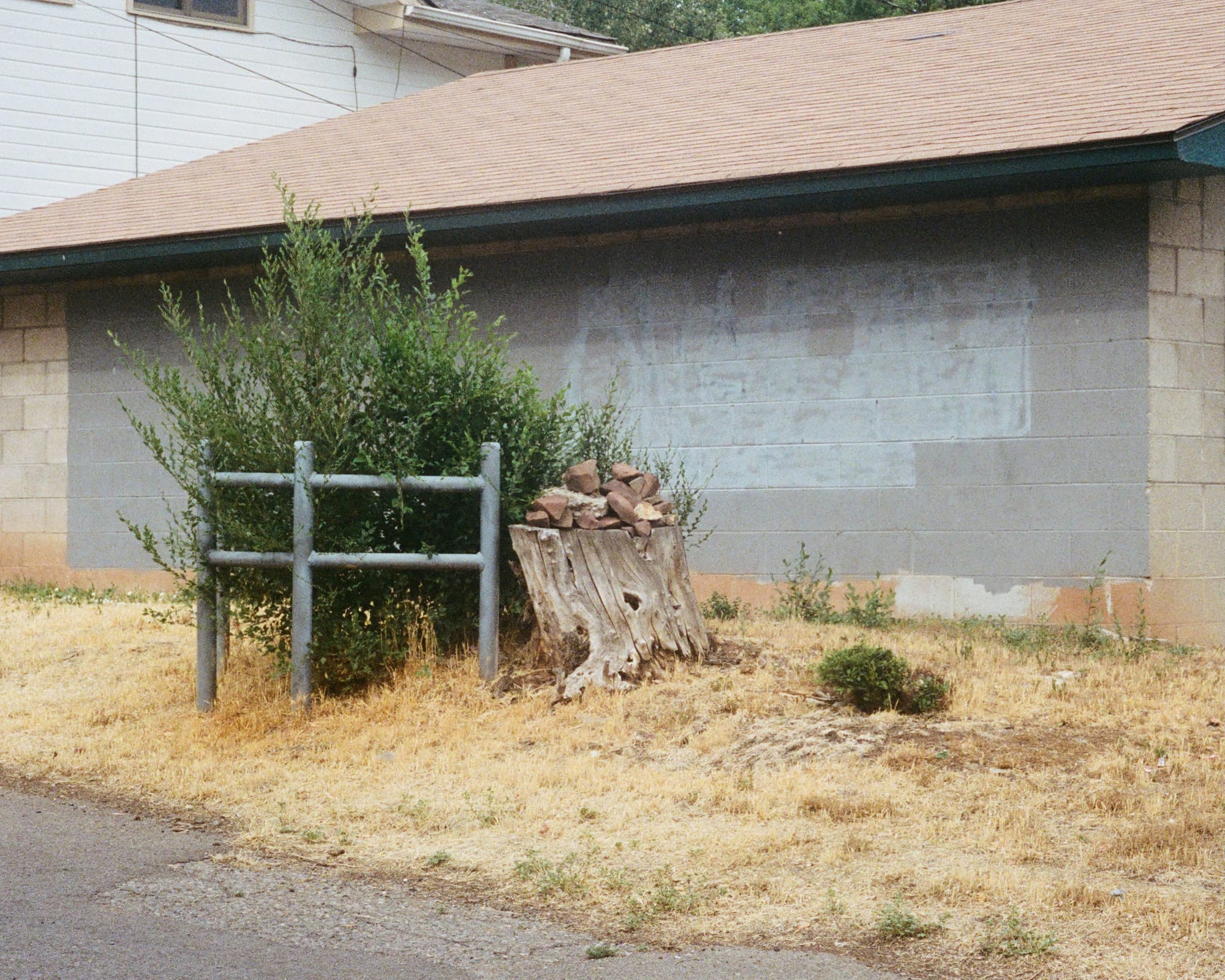
Boundaries

Every year on the same day, two Roman households would walk out to a certain stone that divided their fields.
Each family would crown it with a garland, then build a small altar together. One side carried fire out from their own hearth in a piece of a broken pot to light it. An old man cut the wood, a boy held a wide basket, and a daughter came forward with honeycombs. The offerings were burned, and everyone stayed silent. Then, they celebrated with food and song.
The festival was the Terminalia, for Terminus, the god of boundaries. This scene was from Ovid, who spent a long poem walking through the Roman calendar a day at a time. This story fell on February 23, near the end of the year of the old calendar. The boundary festival aligned against the boundary of the year, honoring a god who keeps the peace between two plots of land. The marker was the communis Terminus: the shared one, the common one.
Something about this story feels strange and lovely. Before surveyed plots, county registers, and case law about property rights, we needed some way of continually establishing where my world ends and yours begins. From what I can tell, this functionally served to enthusiastically renew claims, commitments, and responsibilities around land.
You, obviously, couldn’t do it alone. Not because it was religiously forbidden, but because that’s not how it worked. Where three farms met at a corner, three households came, and all three made the offering. The rite took as many households as the boundary had sides.
Celebration and shared meals evoke this feeling of boundaries opening. You’re invited into my world, or me into yours. It feels like temporarily dissolving whatever sits between us, as if for an evening there is no clear separation. Yet the entire thing was arranged around a rock that marked a line.
This is not quite how I thought of the word boundary for most of my life. My definition was smaller, more rigid. Boundaries are like fences: my boundaries are where I claim what is mine, where I enforce what is in versus out. I hear people talking about boundaries like the “no”’s they should have said, or strategies to prevent access before getting hurt.
Previously, in a workshop about boundaries, I was asked to name four of mine. This was at a time when I was increasingly feeling more open. Uh, I have none, I am open! Okay, fine, maybe I have boundaries, but I don’t have boundary issues. I don’t often feel impinged upon and don’t think I do so to others. Do I? But, fine, I’ll play along.
Something about my parents’ silence about a topic? Not liking the way my wife and I conversed about something? Ah, and a private-equity-owned veterinary clinic refusing to send our dog’s flea prescription to an online pharmacy.
Wait, what? This is not, as far as I know, any kind of standard use of the word. I was clearly having trouble. What were these things? Limits? Requests? Something I wanted? The flea prescription, at least, perhaps touched something closer to normal understandings of boundaries, like “I don’t want to be treated a certain way, and will move my business elsewhere when that happens.”
I don’t think I was just confused. I wanted the word to be able to say something that fence and no didn’t quite say and basically gave up. “I want the boundary to be bigger, I’m not trying to limit things.”
Months later I was still chewing on it with a friend, and they said it easily, the way you’d hand someone the salt: “Oh, yeah. Like a boundary can be complete space.”
I liked that considerably more than I understood it, as if it gave neat structure to how I was feeling. Boundaries can be complete space has the sheen of a phrase that could mean just about anything. Live, laugh, love, my boundaries are all of space. Heh. But it seemed to loosen the concept, and pulled it away from being only about the places we should be saying “no” more.
Could a boundary be something other than a place where possibility stops? Could it, somehow, create space?
Christopher Alexander spent much of his life looking at what boundaries actually do. Obviously a fence is a fence, a wall is a wall. But how does it functionally interact with what’s around it? What does it do?
His own answer arrives as a list of four verbs. Boundaries do “the complex work of surrounding, enclosing, separating, and connecting.” Connecting is right there, sitting next to separation as if they’re equals.
I alluded to this functional sense in the introduction to this series, talking about the alleys that I love in my town: “The private domain of people’s homes meets public, yet lightly trafficked, space. This weird union makes both stronger. The boundary is there, but porous.”
Unclear boundary isn’t always a feature. In The Nature of Order, he showed two examples. The first is a Norwegian storehouse, with edges at every scale. It’s as if it is almost made of them. The second is a condominium block: white slabs, a few coconut palms, bare sand going right up to the building. It has no step, no clear transition anywhere. He writes that it has, “virtually no boundaries at any scale,” that this is “a building without boundaries, and as a result the building is not integrated with its surroundings, or integrated within itself.”
When I thought about boundaries, it’s as if they subtract a little from connection. If you set a boundary with me, then surely we’re less connected? But with the condominium, the missing edge doesn’t produce connection, it produces nothing. Nothing of note is brought together, it’s all wishy washy vague transition until, boom, the building.
Alexander liked boundaries thick, far thicker than a wall. A thick boundary can be an interchange zone. Living systems need “exchange, interchange, flows passing across the boundary, subtle kinds of filtering, places where interaction of the elements coming from either side can take place.” Thickness with porosity doesn’t have to mean vagueness. Even though I can guess where the imaginary property lines are, my alley’s thickness is where the public and private meet and negotiate.
There’s a photograph in the book of Binsted Lane, in the Sussex village where he lived. There’s this narrow road bordered by a grass verge, then a ditch, then a hedge. It’s so intriguing. The road meets the land across three different things. None of which is a clear wall. Water, critters, sound, and headlights interact differently with each.
He thought these sort of zones should be big. “In general it is necessary to think of boundaries as very large.” He’d prefer a wainscot over a simple molding. Years earlier, in A Pattern Language, he’d written an observed rule I suspect sits underneath all of this. “Any homogeneous membrane which has holes in it will tend to rupture at the holes, unless the edges of the holes are reinforced by thickening.” When he observed that edges get thicker at crossings, he was describing physical stress in a wall. I find it fun to consider how this is also true by observation of how things feel. We want door frames and window frames to, in a sense, hold the pressure of that hole. Our eyes and mouths have rings around them of extra bone and flesh that frame them thickly, drawing our attention in.
His use of membrane makes me think of the other kind.
I learned recently that the inner membrane of a mitochondrion is about five nanometers thick.
For decades, biochemists were trying to understand how respiration actually makes ATP. The two ends of the process were clear. At one end, electrons stripped from your food arrive on carrier molecules, and fall down a chain of proteins sunk into the mitochondrion membrane. Each interaction takes away a little energy, until they land on oxygen and make water. At the other end, ADP and a loose phosphate get pushed together into ATP, the small rechargeable battery that powers nearly everything a cell does.
Electrons on carriers and oxygen in, ATP out. But what’s the chemical that connects these two processes?
They knew what they were looking for, a molecule. Cells already do this trick elsewhere, in glycolysis. A phosphate gets handed down a line of molecules, each holding it a little more loosely than the last, until it reaches ADP. We can halt the process and see the intermediate steps. We can measure how much energy each bond carries separately. There was even a common notation, in use since the 1940s: a little squiggle means an energy-rich bond. When this cellular respiration problem was formalized in 1953, the missing molecule went into the diagrams as ~P. Squiggle P.
Then chemists went looking, for twenty-five years. They’d pull mitochondria apart, trying to stop the reactions at exactly the right instant. A few candidates were proposed, published, and withdrawn, as late as 1977. Peter Mitchell would eventually describe those decades as a field “littered with the smouldering conceptual remains of numerous exploded energy-rich chemical intermediates.”
Where was it? Why couldn’t we isolate it? Perhaps ~P was wildly unstable, falling apart before anyone could catch it. But then how was it doing the work? Perhaps it showed up in amounts too small to isolate. But then how do you account for all that ATP? Every explanation was reasonable in a way. What seemed less reasonable, in fact not even popularly considered, was that it wasn’t there.
Peter Mitchell proposed something else back in 1961 that didn’t seem plausible. He and Jennifer Moyle, who worked alongside him for more than thirty years and ran much of the bench work, tested it away from any major lab, in a converted manor house. Their proposal was that the thing wasn’t a thing, directly. Respiration moves protons across the membrane, leaving more on one side and fewer on the other. That’s it, there’s no molecule. Instead, there’s a difference, in concentration and charge.
Chemists were used to a world where everything is a solution of molecules and ions, and this wasn’t quite that. The membrane holds the two sides apart long enough for the protons to come back through one door, a protein called ATP synthase. It’s an actual rotary motor: protons fall through it, a shaft turns, and the turning presses ADP and phosphate together. What? This is not how chemistry works, right?
In 1997 a group glued a fluorescent filament to the shaft and filmed it going around under a microscope, in discrete steps, roughly a hundred times a second. There’s a chemical reaction, needed for life, that runs on a tiny motor driven by protons falling through a hole. Excuse me while this blows my mind.
The protons on the crowded side were not special. They were simply there, on that side of the membrane. In a beaker, chemistry has amounts, more of this and less of that. Here, there was an across.
Mitchell called it “vectorial” chemistry, chemistry with a direction. Across those five nanometers of the membrane, the electric field runs to about thirty million volts per meter, roughly ten times what it takes to tear air into a spark. It’s all held by a soft, shifting layer of fat and protein that gets torn down and rebuilt continuously.
Interestingly, neither a perfectly sealed membrane nor completely open space would work. We’d be dead. If protons could come back immediately, no voltage difference could exist. If they couldn’t come back, nothing would happen.
So must a boundary be thick and hard? Alexander explored this, decades later, spending pages on hairlines. He was studying a thin line of a third color between two other color blocks. The two colors by themselves give a feeling of a divide, just because they’re different. Yet, the hairline mends it, creating a sense of meaning between the colors. He muses that hairlines work exactly the way the big geometric boundaries work, “only the thickness of the boundaries is different.”
Boundary thickness is one of the ways an edge gets to matter. It scales to whatever has to cross, keeping two things distinct enough that something can happen between them.
The same thing appears in the felt sense of a self. This isn’t sensation of your skin, it’s more like the felt edge of “you”. This sense is a bit dynamic, situationally attuned to where you find yourself. In the dark, it might get vague and roomier. In a crowded elevator, it might pull in tight. In fact, we’re great at using tools because we can extend this sense to accomplish tasks. When I’m driving my truck, there’s this sense where the truck is me, and I don’t have to constantly re-calculate its size. When I pull into a parking place, one complete unit is going in. We don’t have to be taught this directly, because it’s felt. It’s constantly defined and re-defined based on what is useful.
Time has this boundary quality, too. I’ve felt this with the passage of my day. I used to bike commute to work, around ten miles a day on safe roads, about forty minutes total. Forty minutes spent whether I wanted to spend them or not. With nothing else to do inside them, I’d binge podcasts or call relatives. I wonder sometimes whether my late grandmother, who had dementia, remembered me the longest of all the grandchildren because of how often I called her as I biked.
I work from home now, and have much less of this. When I wake up my laptop is in my office, ready to engage. Perhaps I want to check on an overnight coding task, or see if I have any messages. Or perhaps I’ll read, or even write. This continues all day. I’m at home, at work, in a way I’m not sure my brain can separate.
The commute was doing more than transporting me, or even allowing me to always have some exercise. It made a here and a there. Alexander noticed how people carry themselves in a particular way while they’re out on the street, a bit more closed and braced. This is hard to drop immediately, unless there’s a transition that destroys the felt momentum. My forty minutes of pedaling functioned as a perspective reset.
Some edges arrive all at once. Two friends of mine had been a couple for years, living together, lives basically merged. One morning they left from the same house to go to their wedding. Weddings have so much buildup: the planning, the coordination, the travel, the fancy clothes, everyone’s loved ones in one room.
Then a sentence gets said. Very little in their lives changes, but their entire world is also different. A before and after, with no married-ish in between.
If boundaries are functional, if they do things, what were mine doing?
Earlier this year, I experimented with an exercise: write down everything I don’t want other people to know about me. It took a while, and the list kept growing. Many of the items weren’t easily waiting to be found. Some were small and stupid. I read far fewer books than I buy. I had weird food aversions based on childhood experiences. Some were not small at all.
I wasn’t after honesty, exactly, or even vulnerability. I wanted to find the force fields, places where I’d constructed my world to avoid. If boundaries are functional and do things, then these were doing something. I wanted to know what.
Here’s a big one: I couldn’t tolerate not knowing what to do next. Trying at something, it not working, and I’m standing there without a next move. It wasn’t necessarily about asking for help, more like: what do I do? I realized I had designed my life around never being close to this feeling.
Much of my adult life has been about creating firm boundaries that give me control. Inside, it’s my domain, I’m responsible, I have this, look how competent I am. Outside, eh. Elegantly constructed walls that may even appear vast from the inside—my boundaries can be all of space, right? It can feel like strength. Nothing unwanted gets through. But then, nothing else does, either. I’d made the inside large and controlled, and confused it with openness. Having boundaries-as-space is often just myopia. The obvious thing might be right there, outside the space where I knew what to do with it.
These aren’t mistakes or failures, directly. A baby in an incubator is being kept from being held, and the not-being-held is what keeps them alive while their own body can’t yet manage it. We don’t put babies in incubators for fun. Walls go up because something needs protecting, and it works.
Prudent protection and dead isolation might look the same from either side of the glass.
The other direction happens too. I’m sure you have people in your life who can’t say no to anything. Every mood passes straight into them, every external desire becomes theirs, and every request turns into an obligation before it’s even been understood. Sometimes these obligations even feel cheery and voluntary from the inside. We often read this as closeness, as someone who is open. Some of the most generous people I know are like this. I love being around them.
And still: can they feel what they want? The lack of a boundary also prevents any charge from forming on their side of the membrane. A hard wall and a wet puddle seem unrelated. One holds its shape no matter what, the other takes whatever shape it’s given. I’ve been both, erecting hard boundaries, and also thinking I have none. I now feel the same cold in both. Neither one is distinct, which seems different than separate. The wall allows no crossing, and the puddle preserves no difference to cross.
My wife doesn’t like asking me to do things directly. Or, more genuinely, the act of asking can feel like nagging. She deeply cares to not be that way. Yet I’ve felt this desire to hear more. We started an experiment: make a request whenever a desire comes up, and I can say no.
One day she asked whether I could clean something up while she was at work. I said yes, did it, and moved on. It didn’t occur to me that anything notable had happened. Later she told me how scary it had been to ask. What made it possible, she said, was knowing I’d tell her if it wasn’t okay with me.
I like how little happened. There was no moment of asserting any strict boundary, yet we created something in the relational space that opened possibility. The thing that made her feel good about asking is having a refusal be available, even when it rarely would come. It lets the request be a request.
Many of the relational boundaries I’ve seen work are like this. They’re not hard lines or claims about what I’ll do if you do something. They’re not even defensive, taking almost no attention. Closer to rules of engagement that make engagement more possible, maybe.
Politeness can be weirdly like this. When meeting someone new, even in a passing encounter, neither of us yet knows which differences matter. So we run a set of small inherited conventions that let us negotiate, without saying so, who we are and which rules we’re each willing to play by. Please, thank you, I’m so glad to meet you, how’re you? They’re like a thick boundary that enables intimacy to slowly grow.
And, like many boundaries, it can get in the way. I remember sitting in a conversation I wasn’t enjoying, both of us carefully continuing, because saying “This doesn’t feel good to me, I’m not enjoying this” seemed unavailable. But our careful tiptoeing wasn’t working. Eventually I said it, ending the conversational nebulosity. The discreteness felt dangerous. Yes, I was being direct, but what I wanted was also snapping into focus, and gently avoiding the strangeness wouldn’t get either of us closer. All of a sudden, the conversation opened. It wasn’t pleasant anymore, but was certainly real.
This is a delicate dance that avoids hard rules. Relationally, we can make asking and refusing easier, and sometimes take a relational risk that might disturb the whole exchange. But in neither case do we get any closer to being inside the other person. Even when it works almost invisibly, something still has to cross between us.
Of course, we can get very close. With my closest friends, a pause halfway through a sentence tells me what the pause means. Conversation runs on many levels beneath the words. But however close we get, their experience can’t become mine. I wonder if most people find this lonely, as though the seam means we aren’t fully connected, can’t be, on some basic level.
It doesn’t feel like that to me anymore. We don’t actually need to hit the edge. In the introduction, I wrote about those hours-long conversations where neither person seems to be steering, yet the thing goes somewhere neither could have gone alone. Neither of us contains the conversation. Somehow it becomes something neither of us owns.
Alexander puts it this way:
“Then the boundary both unites and separates. In both ways, the center that is bounded becomes more intense.”
— Christopher Alexander, The Nature of Order, Book 1
I’m caught by in both ways. The joining isn’t compensation we get back for having paid the separating. Both directions are doing the same work, making the bounded thing more distinctly itself. There’s nowhere else the contact could happen.
This past spring, my wife and I were climbing a couple hundred feet up a cliff. She was leading above me, while I belayed, half standing half sitting inside of a small cave. I couldn’t see her and after a while, couldn’t hear her either. The rope would occasionally move, then nothing, for most of an hour. Something had gone wrong, clearly.
Unbeknownst to me, she had dropped an important piece of climbing gear, so was slowly and carefully improvising then testing a solution so that I could safely climb. Eventually I learned that she was okay, but at the time, I had no idea.
I was ready to catch her if she fell. We were connected, quite literally, by a rope rated to hoist a small car. Our hairline connection allowed her to be up there, making one of us the leader and one of us the belayer. But it couldn’t tell me anything about what she was going through.
Every so often, the rope moved. I’d feed out a few inches, knowing she was still moving.
Music in the audio version by my friend Jordan Welsh, photograph by my friend Noah Maier, and words by me. If you’re just finding this, start at the introduction. The prior essay is Strong Centers.